
Aluminum Gravity Casting RFQ for A356/ZL114 Parts
Permanent-mold gravity casting with A356 and ZL114 alloys for housings, brackets, manifolds, and OEM RFQs that need tooling, CNC machining, leak-risk review, and inspection planning.
What gravity casting is best for
Gravity casting is often a strong fit for dense, structural, T6-friendly, and leak-test-sensitive aluminum parts where wall thickness runs 5-15 mm and porosity risk must be planned. Compared to high-pressure die casting, the cycle is slower, but the route can be better suited to thicker sections, heat treatment, machining stability, and inspection-led qualification. It is often reviewed for pump housings, valve bodies, structural brackets, and industrial equipment housings in automotive, EV drivetrain, and industrial OEM-style supply chains.
Related product RFQ examples
Gravity casting parts with product-level RFQ packages
These product pages show the drawing package, annual volume, material/process, machining, inspection, and follow-up details Bohua needs before quoting an OEM gravity casting program.
A356-T6 pump housing RFQ example
Pressure-sensitive gravity casting page with RFQ package notes for drawing, machining, leak test, and inspection scope.
View product RFQ package →A356 gearbox housing RFQ example
Industrial reducer housing page for buyers comparing gravity casting, T6 heat treatment, CNC datums, and export documentation.
View product RFQ package →Truck intake manifold RFQ example
Automotive A356-T6 gravity casting page for OEM buyers reviewing runner geometry, flange machining, and sample validation.
View product RFQ package →Hydraulic valve body RFQ example
Fluid-control product page for buyers who need sealing faces, ports, bores, and inspection requirements reviewed together.
View product RFQ package →Quote decision gate
When gravity-casting research should become an RFQ
Gravity casting is usually worth a formal review once the buyer has a drawing, approximate volume, and one critical reason the route is being considered. Use the table below to turn a research question into quote inputs without making unsupported process or property promises.
| Buyer signal | Commercial risk | Ask for these RFQ inputs |
|---|---|---|
| A356 / ZL114 housing with 5-15 mm wall sections | Wrong route can create tooling, heat-treatment, and machining assumptions that are hard to compare across suppliers. | Wall-section range, envelope size, alloy target, annual volume, tooling status, and whether low-pressure casting should be compared. |
| Pump, valve, or fluid-path housing with leak or pressure concern | Unit price is not comparable unless leak-test method, machined sealing faces, and acceptance records are named before quotation. | Leak medium, pressure or hold time, acceptance criterion, machining datums, CMM needs, and X-ray or pressure-test record expectations. |
| T6 heat treatment, bearing seats, or structural validation | A quote can look complete while hiding distortion, fixture, inspection, or sample-approval assumptions. | Temper target, datum plan, bearing or sealing tolerances, FAI/PPAP scope if required, sample quantity, and destination/Incoterm. |
RFQ package
What to attach for a gravity-casting quote
Use this package when the buyer is ready to move from process research to a quote-ready review. It keeps engineering, sourcing, and quality assumptions attached to the inquiry.
- PDF drawing plus STEP model, with revision status and critical dimensions marked
- Alloy route such as A356, ZL114, or supplier recommendation if the material is still open
- Wall-section range, target part weight, annual forecast, first batch quantity, and project stage
- Machining datums, bearing seats, sealing faces, threads, and surfaces that drive inspection risk
- Heat-treatment target, leak or pressure test method, CMM scope, FAI/PPAP-style records if required, and destination/Incoterm
Why Gravity Casting
6 Reasons Engineers Choose
Gravity Casting
Mechanical-Property Planning
Gravity casting can support dense, T6-compatible A356 and ZL114 parts when gating, feeding, heat treatment, and inspection scope are planned around the drawing.
Large Part Capability
Our process can review parts up to 1.2 m in maximum dimension, including intake-manifold style housings where mold design, handling, machining allowance, and inspection planning must be aligned before quotation.
Process Monitoring
Operators track pour temperature, fill behavior, heat-treatment records, and inspection results so production assumptions can be reviewed against the RFQ and control plan.
Cost-Effective Tooling
Gravity casting tooling is often a lower-investment route than high-pressure die casting tooling. Final tooling cost and timing are confirmed after part geometry and mold-complexity review.
T6 Heat Treatable
A356 and ZL114 gravity castings can be reviewed for T5 or T6 heat treatment when the drawing, wall section, mechanical targets, distortion risk, and validation method are defined.
Pressure-Risk Planning
Gravity casting can be reviewed for pump housings, valve bodies, and other leak-risk parts when the buyer defines leak-test method, pressure, hold time, and machining exposure.
Our Process
From Design to
Finished Part
Mold Design & Tooling
DFM review, gating system design, thermal analysis. Tooling fabricated from H13 tool steel.
Melt & Alloy Control
Oxford spectrometer verifies alloy composition before each pour. Degassing treatment for porosity control.
Automated Gravity Pour
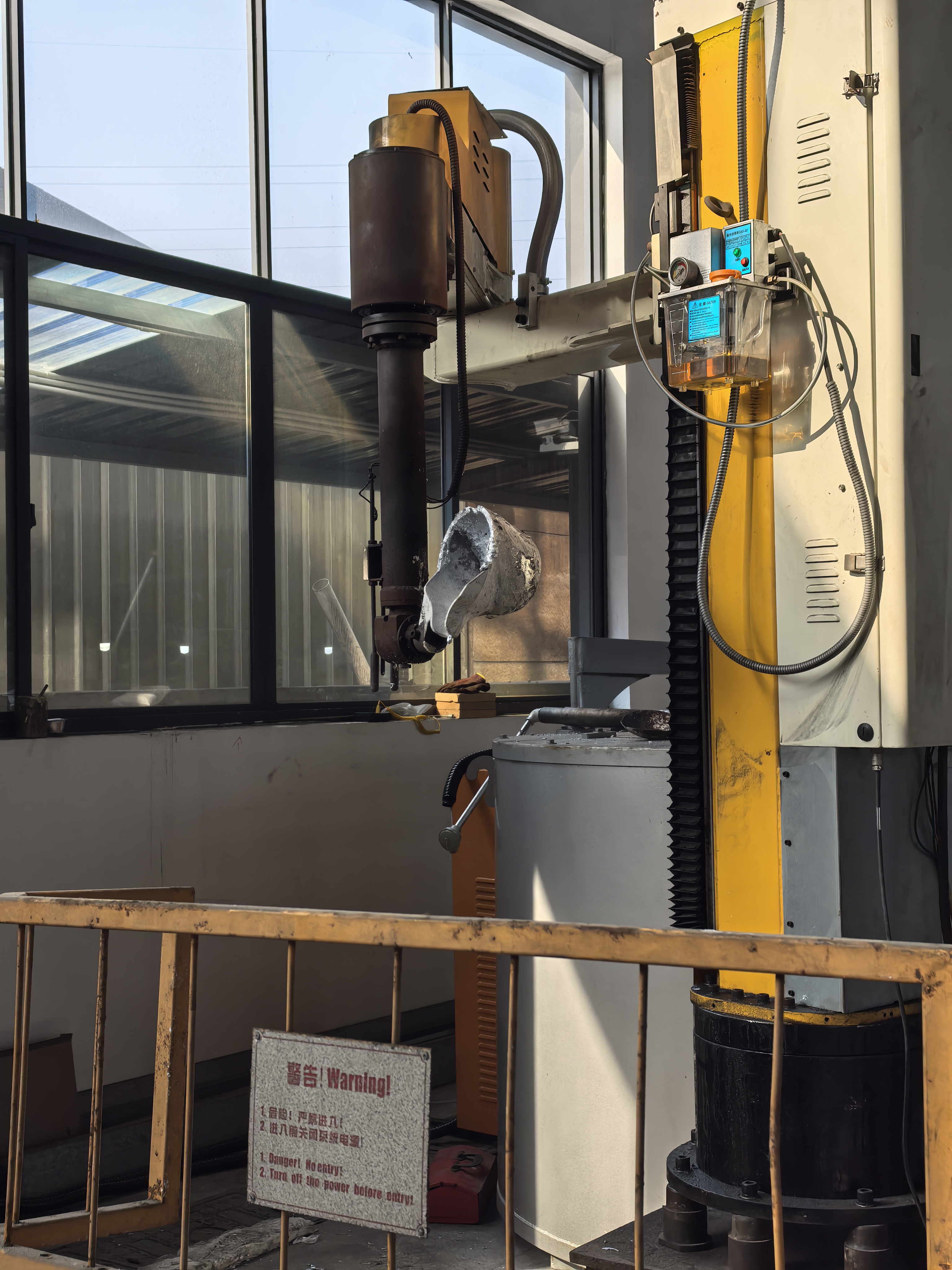
Automated tilt-pour machines help maintain consistent fill speed and temperature, with cycle records reviewed against process assumptions.
Controlled Solidification
Cooling rates optimized per geometry. Directional solidification for critical sections.
Heat Treatment
In-house T5/T6 treatment. Temperature-controlled furnaces, quench tanks, aging ovens.
Machining & Finishing
CNC machining to final dimensions. Deburring, shot blasting, surface treatment as required.
Inspection & CMM
X-ray NDT, CMM dimensional check, mechanical property testing. Traceability aligned with IATF 16949 controls.
Part family suitability
| Part family | Alloy fit | Wall (mm) | Heat treat | Inspection priority |
|---|---|---|---|---|
| Pump housings | A356 / ZL114 | 5–12 | T6 | Leak + CMM |
| Valve bodies | A356 / ZL114 | 4–10 | T6 | Leak + dimensional |
| Brackets / structural | A356 | 6–15 | T6 | Dimensional + UT |
| Industrial equipment housings | A356 / ZL114 | 6–20 | T5/T6 | Dimensional |
| Reducer / gearbox housings | A356 | 8–15 | T6 | Bearing-seat CMM |
Gravity vs Low-Pressure vs HPDC
How to choose the right casting route for your program.
| Criterion | Gravity | Low-Pressure | HPDC |
|---|---|---|---|
| Wall thickness sweet-spot | 5–15 mm | 4–12 mm | 1–4 mm |
| Cycle time | Minutes | Minutes | Seconds |
| Gas-entrapment risk | Lower when controlled | Low when process fit | Higher without added controls |
| T6 friendliness | Yes | Yes | Usually no |
| Tooling cost | Medium | Medium-high | High |
| Best for | Structural, leak-test-sensitive | High-density, sealing | High-volume thin-wall |
Related Resources
Go Deeper into Gravity Casting
Sourcing Categories
Technical Articles
Ready to Quote a Gravity Casting Part?
Send drawings, alloy target, annual volume, machining scope, and inspection requirements so engineering can assess process fit and RFQ assumptions.
Send Gravity Casting RFQ