Ningbo Bohua Mechanical Parts Co., Ltd. · Linda, Export Sales · linda@ningbobohua.com · www.bohua-casting.com
Application
Aluminum Dewatering Pump Volutes and Housings
Specify the minimum finished wall and sealing faces on an aluminum dewatering pump casting. Give the wet end and submersible motor housing separate test requirements, and check the metal left around the discharge neck and cable entry after machining. Bohua casts and machines aluminum pump housings in batches and offers a free drawing review.
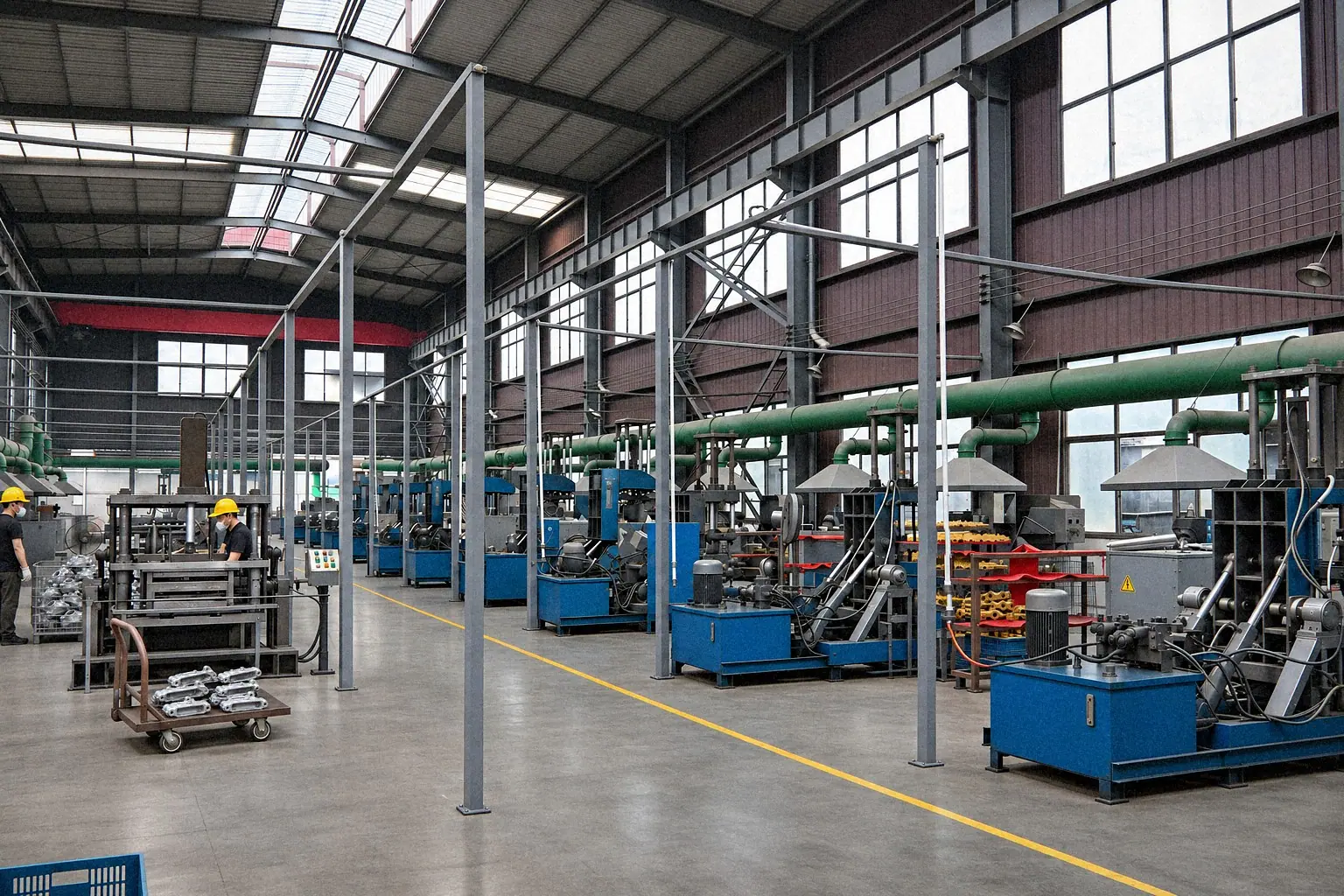
What does a dewatering pump casting need?
For a submersible dewatering pump, draw the water path and the motor enclosure as separate boundaries. The volute needs a defined hydraulic profile and minimum finished wall. The motor housing needs a clear sealing arrangement at the end cover, shaft-seal interface, and cable entry.
| Component or check | What the drawing should control | What to verify |
|---|---|---|
| Aluminum pump volute | Scroll and tongue geometry, discharge neck, and minimum remaining wall | Core position, wall at the outlet transition, and the finished seal face |
| Pump body or cover | Impeller clearance, locating register, gasket land, and bolt pattern | Inspect the locating features and sealing surfaces in the finished condition |
| Submersible motor housing | End-cover joint, cable entry, and shaft-seal location where applicable | Check the gland seat, joint surfaces, and motor enclosure separately |
| Assembled pump | Specify the tests required for the pump design and contract | ANSI/HI 14.6-2022 covers hydraulic and hydrostatic tests. ANSI/HI 11.6-2022 covers submersible pump mechanical and electrical integrity. |

Where should the drawing control the wall and sealing faces?
Specify the minimum finished wall at the sections that carry pressure or lose material during machining. Check the volute tongue, discharge neck, fastener bosses, and the metal beside the cable-entry bore. Dimension the minimum remaining wall along the shortest relevant section. If a cored surface sits behind a finished feature, locate the core relative to the datum used to machine that feature.
Put the gasket land, register, and face flatness requirements on the finished drawing. Review where the parting line and any ejector marks may fall for the selected casting route. For the cable entry, show the thread or bore, gland seating face, and permitted breakout into the enclosure. Identify any coating that changes the fit or must be kept off a seal land.
Worked example of wall remaining below a cable-entry spotface
Assume the drawing requires a minimum finished wall of 4.5 mm (0.177 in) beside the cable bore under the spotface. The values are hypothetical. All losses are measured along the same section, and the casting allowance already includes core shift.
| Input or result | mm | in, rounded |
|---|---|---|
| Nominal cast wall | 6.0 | 0.236 |
| Assumed local loss from casting variation and core shift combined | 0.5 | 0.020 |
| Maximum spotface cut | 1.5 | 0.059 |
| Remaining wall under these assumptions, 6.0 − 0.5 − 1.5 | 4.0 | 0.157 |
| Shortfall from the drawing minimum | 0.5 | 0.020 |
The remaining wall is 4.0 mm (0.157 in), which is 0.5 mm (0.020 in) short of the requirement. If the gland still seats correctly, review a shallower spotface or a thicker boss with the pump designer. The designer sets the required wall and validates it for the expected loads and service conditions.
How do you specify A356 and separate the tests?
Evaluate gravity permanent mold, including tilt-pour, for repeat volutes where the scroll can be formed and the core located consistently. Consider low-pressure casting if the geometry benefits from controlled filling. Review sand casting for complex cored passages or when release sizes make permanent tooling hard to justify. Compare routes against the same finished drawing and inspection scope. See tilt-pour gravity casting for cored aluminum parts.
If your drawing calls for A356-T6, confirm the material and temper before release. For a permanent-mold order under ASTM B108/B108M-19, the A356.0 entry specifies T61. ASTM B108/B108M-25 is the current edition. State the contract edition and unit system. Check the applicable row for separately cast specimens or specimens from the specified casting location.
Keep the casting leak check, hydraulic or hydrostatic pump acceptance, and motor enclosure integrity tests separate in the RFQ. For the casting check, identify the cavity, fixture closures, medium, pressure, stabilization time, hold time, and failure criterion. Use the casting leak-test specification guide to prepare those inputs. Assign the assembled pump tests to the responsible party in the RFQ. If a chamber needs a quantitative leakage limit, specify the method and units needed to measure it.
Sources include ASTM B108/B108M-19 and B108/B108M-25, ANSI/HI 14.6-2022, and ANSI/HI 11.6-2022.
At Bohua
Bohua casts and machines aluminum pump housings in batch production. The drawing review is free. Send the volute section and the motor enclosure joints so the review can address the route, machining, and inspection.
We run gravity casting, including tilt-pour, low-pressure casting, sand casting, and die casting on two machines rated at 280 t and 450 t, all in-house. The die casting machines suit small and medium parts that fit the tooling and available clamp force. For larger castings, we evaluate gravity, tilt-pour, low-pressure, or sand casting. The project is outside our scope if none fits. We cast A356 and ZL114 by gravity and tilt-pour. We perform T6 heat treatment in-house.
Routine production typically meets GB/T 11346-2018 Grade 3–4; with tighter process control, sampled parts are around Grade 2; when the customer specifies it, every casting is X-rayed and shipped parts meet Grade 1. Industrial CT is available through an outside lab.
Leak testing at Bohua is done by air-under-water immersion at 3 bar or more. This checks the casting for leaks. The test pressure for a particular casting follows the customer drawing. Bohua offers fatigue testing and Production Part Approval Process (PPAP) support up to Level 5. We design and make molds in-house.

What should go on the drawing and the pump casing RFQ?
Send a finished model, sectional drawing, annual quantity, and release schedule. The pump housing RFQ guide lists general inputs for pump castings. Call out the minimum finished wall at the cable entry and discharge neck. Mark the volute tongue, locating register, gasket lands, and gland seat as applicable. Specify where to check wall thickness, which areas to X-ray, and what reports must ship with the castings.
List the acceptance criteria for each chamber in the pressure-tight pump casing RFQ. Add the operating liquid, expected solids, and whether the drawing calls for an abrasion liner or a coating. Send separate drawings if the motor housing and wet end use different material or acceptance requirements.
U.S. duties can differ substantially between machine parts and other aluminum articles under heading 7616, so consult the U.S. tariff guide for aluminum castings and have a customs broker confirm each part.
In the EU’s 2026 tariff schedule, pump parts classified under CN 8413 91 00 carry a 1.7% conventional duty and are outside CBAM Annex I as of November 22, 2026, subject to entry-specific measures and the final text of any scope change.
Sources include Commission Implementing Regulation (EU) 2025/1926 and Regulation (EU) 2023/956, Annex I.
Dewatering pump casting questions
Can I use one leak-test note for the volute and motor housing?
It depends on the design. Write separate test instructions if the chambers use different closures, pressures, or failure criteria.
Can the volute scroll stay as cast?
Yes, if the cast profile and core position meet the pump design. Mark surfaces that control hydraulic performance or running clearance.
Does a radiograph prove the casting is leak-tight?
No. Radiography checks for internal discontinuities. Use the drawing-specified leak test to assess the finished pressure boundary under the agreed conditions.
Can I specify only a nominal wall?
No. Give the minimum wall after machining at the critical sections and identify where to measure it.
Get a free dewatering pump casting drawing review
Use the pressure-tight pump casing RFQ for your wall, sealing, cable-entry, and test requirements. Include the wet-end and motor housing drawings. Submit the RFQ details, then email your drawing for review.
Send your drawing →