Ningbo Bohua Mechanical Parts Co., Ltd. · Linda, Export Sales · linda@ningbobohua.com · www.bohua-casting.com
Casting process
Tilt-Pour Aluminum Casting at Bohua
Bohua operates 32 tilt-pour machines for aluminum gravity casting in Ningbo, China. Some of these machines were designed and built in-house. The process uses a permanent mold that tilts during filling. Review the equipment range, sand-core requirements and finishing scope below, then send your drawing and acceptance requirements for a project review. Bohua's quality management system is certified to IATF 16949:2016 by NQA.
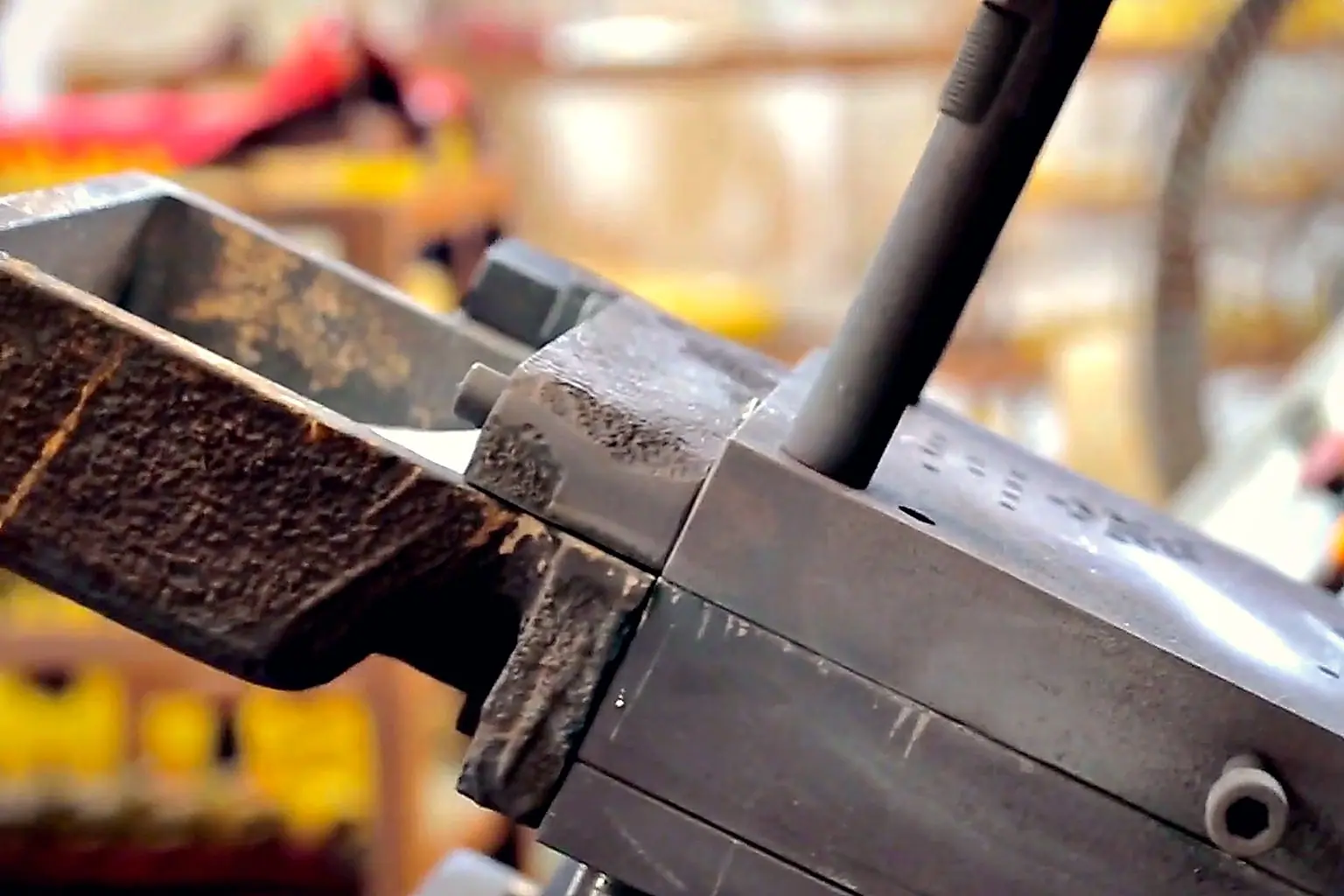
How the mold fills during tilt pour
Tilt-pour casting is a gravity casting process in which the pouring cup and permanent mold rotate together as metal enters the cavity.
The short video shows the pouring cup being filled and the die tilting.
- Fill the pouring cup. A ladle transfers molten aluminum into the cup.
- Tilt the die. Rotation changes the orientation of the cup and mold as metal flows into the cavity under gravity.
Share the part geometry, core arrangement and mold layout so we can review whether rotation suits your proposed casting.

For the broader equipment offering, see the gravity casting overview. The gravity casting process guide covers the full production sequence and control points.
Tilt-pour equipment and casting range
At Bohua, 32 tilt-pour machines support a casting range extending from below 0.2 kg to above 30 kg.
At Bohua
Some of these machines were designed and built in-house. The tooling workshop has 17 machines. Molds are designed and made in-house.
| Feature | Dimension (mm) | Weight (kg) | How to use it |
|---|---|---|---|
| Mold longest edge | >800 | Not applicable | Submit the mold envelope for equipment-fit review. |
| Aluminum per pour | Not applicable | >30 | Pour weight is separate from the finished casting weight. |
| Casting weight | Not applicable | From <0.2 to >30 | Send the estimated casting weight with the drawing. |
| Largest casting, longest dimension | >600 | Not applicable | Check the full geometry and handling requirements. |
| Minimum wall thickness | About 3 mm typical; 2.5 mm over small areas near the gate | Not applicable | Identify critical walls and section transitions. |
The greater-than figures describe a range extending beyond those values. They are not maximum ratings. Review these values separately, then send your drawing so we can assess the combined size, weight and wall requirements for your part.
Include overall dimensions, casting weight and any existing tool information in the review. Define the proposed mold arrangement and available clearance for rotation before committing to a tool.
Sand cores for internal cavities
Some Bohua tilt-pour castings use sand cores, supported by 10 hot-box core shooting machines.
A sand core can form an internal cavity within a permanent mold casting. This is distinct from using a sand mold for the external shape. For that separate route, see in-house sand casting.

For a cored tilt-pour proposal, mark the internal passages and provide:
- The internal geometry and any surfaces requiring machining.
- Openings for core support, removal and internal cleaning.
- Critical wall thickness around the core.
- Access for dimensional inspection and any internal acceptance requirements.
For a proposed outlet or manifold, use the coolant water outlet casting requirements or intake manifold casting requirements to organize the application inputs.
From tooling to a finished part
Bohua combines tooling, sand-core making, casting, T5/T6 heat treatment, CNC machining and inspection at its site of about 16,300 m².
At Bohua
Bohua has casting experience since 1994. A356 and ZL114 are used for gravity and tilt-pour work. T5/T6 heat treatment is performed in-house.
Most molds use GB 45 carbon steel, with H13 for higher requirements. A356 permanent molds typically last about 20,000–50,000 shots. That range applies to GB 45 carbon-steel molds; H13 molds last about 100,000 shots with regular maintenance. First article takes 5–6 weeks from drawing confirmation.
Specify the alloy and heat-treatment condition separately from the dimensional requirements. Mark machining datums, sealing faces, bores and threads. State whether the delivery scope is a rough casting or a machined part.
Use the A356 material page, ZL114 material page and casting and CNC machining capabilities for the detailed requirements.
Define acceptance for the proposed part
Specify the inspection areas, methods, sampling and acceptance criteria for your tilt-pour project.
At Bohua
Available equipment includes an Oxford optical emission spectrometer, a vacuum hydrogen analyzer, Unicomp UNC-160 and Y.MU2000-D X-ray systems, and Hexagon Global S and NANO Metrology coordinate measuring machines.
Pressure tightness is tested by air-under-water immersion, with capability at 3 bar or more within the equipment range. Test pressure, duration and acceptance criteria are project-specific. Impregnation is used only with customer approval and is performed by a qualified subcontractor.
PPAP documentation is available up to Level 5, according to project requirements.
For pressure-tight parts, specify the test medium, pressure, duration and allowable leakage. Identify the test stage and any restriction on impregnation. For X-ray inspection, identify the viewing areas and the required acceptance criteria. See quality control and inspection equipment for the broader capability.
Prepare a tilt-pour quotation request
Send the drawing and project requirements together so the filling route, cores and finished-part scope can be evaluated together.
- Current dimensioned drawing, revision, CAD model and controlling specifications with editions.
- Alloy, heat-treatment condition, overall dimensions and estimated casting weight.
- Internal passage geometry, core requirements, machining datums and finished tolerances.
- Annual demand, order quantities and requested delivery schedule.
- Inspection methods, areas, acceptance limits, required reports and PPAP level.
- Existing tooling ownership, condition and modification limits, if applicable.
At Bohua, quantities are quoted by annual volume; small batches are negotiable. Submit a tilt-pour casting quotation request with the available project inputs.
Send a drawing for a tilt-pour review
Include internal passages, alloy, annual volume, machining scope and acceptance requirements. Not sure which process fits? Tell us what the part must do. In a free drawing review, our engineers recommend a process and suggest design changes where needed.
Send your drawing →