Ningbo Bohua Mechanical Parts Co., Ltd. · Linda, Export Sales · linda@ningbobohua.com · www.bohua-casting.com
Application
Aluminum Castings for Data Center Liquid Cooling: Enclosures, Brackets, Pump and Valve Parts
Aluminum castings fit the dry side of data center liquid cooling first: enclosures, brackets, pump bases, mounting frames and fan parts for heat-rejection equipment. A coolant-wetted aluminum pump housing, valve body or manifold is an option only where the system maker approves the material, coolant and validation. OCP's propylene glycol coolant guideline lists no aluminum among its acceptable metals. The drawing review at Bohua is free.
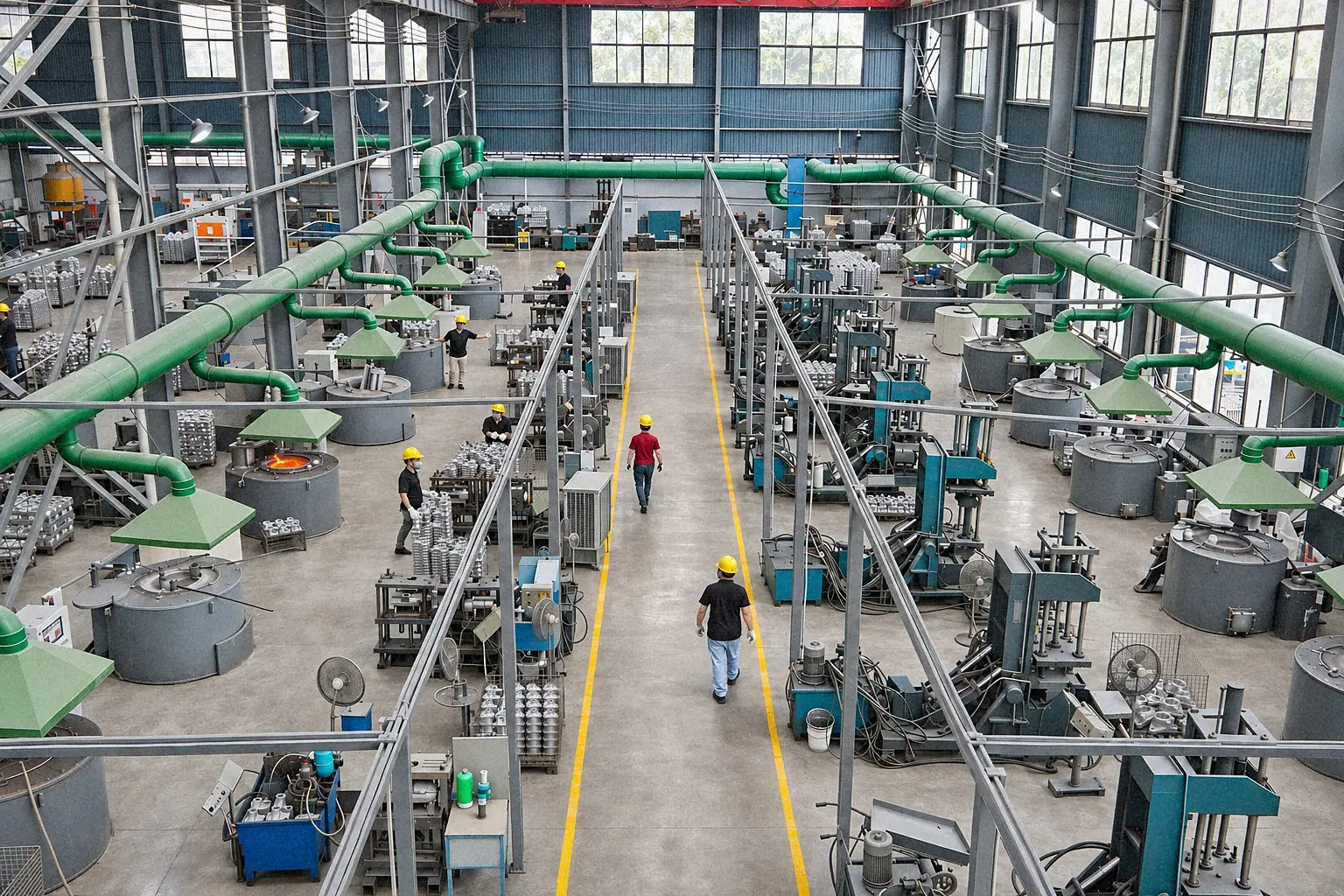
Where do aluminum castings fit in data center liquid cooling?
One question sorts the parts: does it touch coolant? Enclosures, brackets and pump bases stay dry, so the coolant does not limit the alloy. A wetted part must be on the system maker's wetted-material list before tooling starts.
| Part | Touches coolant? | Material in published data | Aluminum casting fit | Put on the drawing |
|---|---|---|---|---|
| Enclosures, covers, brackets and frames on a coolant distribution unit (CDU) | No | Varies by maker | Good candidate | Datums, stiffness, grounding, coating |
| Pump base | No | Die-cast aluminum (one multistage pump) | Good candidate | Bolt pattern, flatness, load path |
| Valve actuator end caps | No | Cast aluminum (one pneumatic actuator) | Good candidate | Seal grooves, threads, mounting pattern |
| Dry cooler and cooling tower fan blades and hubs | No | Cast aluminum blades (one tower fan); aluminum hubs | Good candidate | Balance, shaft fit, corrosion exposure |
| CDU pump casing and impeller, technology cooling system (TCS) | Yes | Wetted list in one CDU specification: stainless steel, copper, EPDM | Only with system maker approval | Pressure, coolant, seals, leak test |
| Pump casing, facility water system (FWS) | Yes | Cast or ductile iron volute (one HVAC pump) | Only with system maker approval | Water treatment, pressure class, flanges |
| Valve body | Yes, unless seat-isolated | Bronze or iron; one butterfly valve offers aluminum behind an isolating seat | Candidate if seat-isolated; otherwise only with approval | Ports, seat, pressure class, leak test |
| Rack manifold and cold plate (TCS) | Yes | Stainless steel, copper or listed polymers; copper cold plates | Usually not aluminum | The system maker's specification |
Material column: published pump, actuator, fan and valve data, checked 2026-11-21; OCP Project Deschutes 1.0.0 for the CDU; OCP rack manifold white paper, Table 9.
For volutes and covers, see the pump housing casting page; for ports and seats, the valve body casting page.
Can aluminum and copper share a coolant loop?
Not as bare metals, unless the system maker has qualified that exact combination. Aluminum is anodic to copper, so it corrodes when the two touch in a conductive coolant. Dissolved copper can also plate onto aluminum and corrode it without contact (deposition corrosion). ASHRAE TC 9.9 notes that aluminum is normally avoided in these loops unless a coating or other surface treatment keeps it out of the liquid shared with other metals.
This page covers single-phase cold-plate loops with water or glycol coolant. ASHRAE adds that aluminum may be considered with a dielectric liquid, so immersion and two-phase systems need their own review.
Name the complete inhibited fluid: propylene glycol, ethylene glycol or treated water. OCP's PG25 base specification (July 14, 2026) sets PG25 at 25–28% propylene glycol by weight, about 24.5–27.5% by volume, and tests corrosion on copper, brass and stainless steel only. OCP's earlier guideline leaves aluminum coupons out and keeps all coupons apart, so a data sheet that lists aluminum does not prove a coupled loop. PG25 fluids from different suppliers are not automatically interchangeable, so do not swap them without approval.
Coolant references: ASHRAE TC 9.9, Water-Cooled Servers (2019), Table 2; OCP PG25 Base Specification 1.0.0; OCP propylene glycol guideline; AMPP Materials Performance (September 2023).
What should the casting inspection plan cover?
Give each check its own acceptance criterion. OCP's Project Deschutes specification lists porosity in cast or molded fittings as a small-leak failure mode, with X-ray among the tests.
| Check | Specify on the drawing or inspection plan |
|---|---|
| Leak and pressure | Test medium, pressure, hold time, sealed ports and permitted leakage. Test after final machining where machining cuts a pressure wall or sealing face. Define proof and burst tests separately. |
| Internal soundness | X-ray zones around ports, bosses and pressure walls, with reference images, severity level and frequency. ASTM E2422-22 has digital reference images for aluminum castings 6.35 mm (1/4 in) and 19.1 mm (3/4 in) thick; for film it refers to ASTM E155. |
| Surface treatment | Coated areas, coverage at machined ports and inserts, masking, and how a barrier coating is checked after machining. |
| Cleanliness | Washing, particle and residue limits, core-sand removal, drying and port caps. OCP's propylene glycol guideline recommends side-stream filtration finer than 5 µm to protect cold-plate microchannels. |
| Dimensions | Seal-face flatness and finish, port standard, threads, datums and the measuring condition. OCP's rack manifold white paper sets O-ring sealing areas at Ra ≤ 1.6 µm (63 µin), depending on seal type and size. |
Worked example: burst pressure from MAWP
OCP's rack manifold white paper sets the minimum burst pressure at three times the maximum allowable working pressure (MAWP). When a system maker adopts that rule for a wetted casting, start from the MAWP, not the normal operating pressure. With an MAWP of 400 kPa gauge (58 psig), the casting must not burst below 3 × 400 = 1,200 kPa gauge (174 psig). Write the production leak test as a separate line.
Inspection references: OCP rack manifold white paper (v3 file), Table 3 and section 5; OCP Project Deschutes, Table 12.1.1; ASTM E2422-22.
What six things should you send with a liquid cooling casting drawing?
Send the released drawing with its assembly context and acceptance criteria.
- Part and loop. Drawing revision, model and loop side (FWS, TCS or dry). Mark every wetted face and passage.
- Fluid and materials. Approved coolant, alloy and temper, seals, inserts and the system maker's material limits.
- Service and testing. Operating conditions, MAWP, test method, pressure, hold time, leakage criterion and records.
- Interfaces and dimensions. Sealing faces, datums, threads, fittings and machined features, with units and tolerances.
- Quality and finish. X-ray zones and acceptance, surface treatment, cleaning and packaging for open ports.
- Delivery scope. Delivery condition (as-cast, heat-treated or machined), assembly exclusions, annual volume and receiving requirements.
The coolant water outlet RFQ inputs show how to describe passage geometry and sealing interfaces.
What can Bohua review from your drawing?
The free drawing review starts with what the part must achieve. Our engineers then check which casting process suits the part and suggest where the design could change. You decide which changes go into the drawing.
- Casting since
- 1994
- Casting processes in-house
- 4
- Die casting machines
- 280 t and 450 t
- Leak test (air-under-water)
- 3 bar or more
- Drawing confirmation to first article
- 5–6 weeks
At Bohua
We cast and machine aluminum pump housings, valve bodies and impellers in batch production. Gravity casting with tilt-pour is our primary process. Low-pressure casting (since 2014), die casting and sand casting are also done in-house. Gravity and tilt-pour parts are A356 or ZL114; die-casting alloys follow your specification. Some tilt-pour parts use sand cores from our 10 hot-box core shooters.
We design and build our own tooling. T5/T6 heat treatment, CNC machining, X-ray and CMM inspection are on site. Leak testing at Bohua is done by air-under-water immersion at 3 bar or more. When your drawing sets its own test pressure, we test to the drawing. Our quality management system is certified to IATF 16949:2016 by NQA.
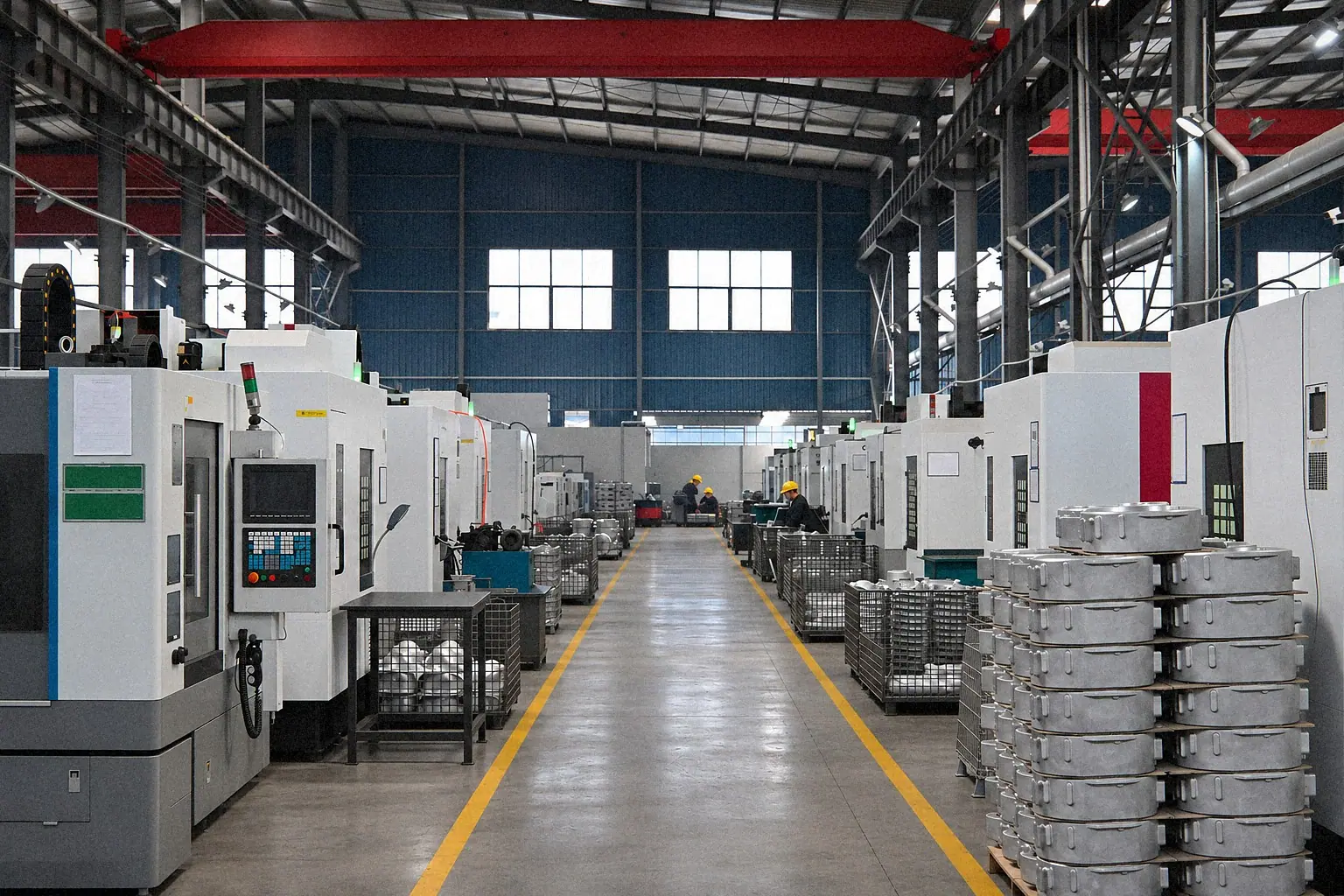

Below are housings and covers cast at Bohua, with customer logos and part numbers masked.
See pressure-tight casting and immersion testing, the die casting process for thin-wall covers and U.S. tariffs on aluminum castings from China for landed cost. Send your drawing for a free review.
Buyer questions about liquid cooling castings
Does PG25 approval cover an aluminum casting?
No. OCP's PG25 base specification tests corrosion on copper, brass and stainless steel only, and OCP's propylene glycol guideline lists no aluminum among its acceptable metals. The system maker qualifies the alloy, surface and loop together.
Which parts of a coolant pump stay dry?
In a pump with a mechanical seal, the base, motor bracket and motor stay dry; the casing and impeller carry coolant. One published multistage pump uses a die-cast aluminum base, a cast iron motor bracket and AISI 304 stainless steel casings.
Can Bohua cast wetted aluminum pump housings and valve bodies?
Yes. We cast and machine aluminum pump housings, valve bodies and impellers in batch production. For a coolant loop, send the system maker's approved material, coolant and validation plan.
Can X-ray replace a leak test?
No. X-ray shows porosity and inclusions in the marked zones. A leak test finds a through-leak at the agreed pressure. A pressure-boundary casting needs both.
Send your liquid cooling drawing for free review
Mark wet and dry surfaces, and include the approved coolant, machined interfaces and acceptance tests. Submit the RFQ details, then email your drawing for review.
Send your drawing →